

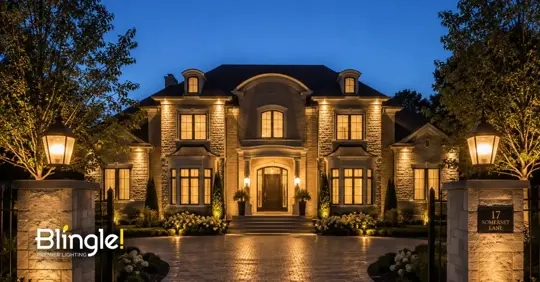
How Outdoor Post Light Fixtures Can Update Your Property
A well-placed outdoor post light fixture does something few other upgrades can match: it makes your property look intentional, polished, and safe — all at once, and from the street. Whether you're framing a driveway, guiding guests down a walkway, or anchoring your front yard with a focal point, post lights deliver a curb appeal upgrade that works around the clock.
And homeowners are paying attention. Strong curb appeal adds an average of 7% to a home's sale price — rising to 10–11% in slower markets — and 92% of real estate professionals recommend improving curb appeal before listing. Post lights are one of the most visible, highest-impact ways to get there. This guide covers everything you need to choose, place, and spec the right fixtures for your property — plus when to call in a professional for the best result.
The Post Light Comeback
Lamp posts were once standard issue in American neighborhoods — lining driveways, illuminating mailboxes, and standing sentry at front walks from the 1950s through the 1970s. Then tastes shifted, budgets tightened, and the post light largely disappeared from residential landscaping for a generation.
But they’re back — and better than ever. Today's outdoor post light fixtures bear little resemblance to the weathered relics of mid-century suburbia. Modern versions are available in every architectural style, integrate seamlessly with smart home systems, and run on energy-efficient LEDs that slash maintenance and operating costs. LEDs now represent over 58% of the entire lighting industry, and the shift is reshaping what's possible in residential outdoor lighting.
Here's why post lights are earning their place back in the yard:
Curb appeal as a vertical landmark. Most landscaping lives at ground level — mulch, flowers, pathway lights, low hedges. A post light adds height and presence, creating a visual anchor that frames your property and gives passersby the "this house is well-cared-for" impression from the street.
Safety and wayfinding. Post lights illuminate drive edges, mark the start of walkways, highlight address numbers, and help guests navigate your property confidently after dark — all without requiring them to fumble for a phone flashlight.
Security without the floodlight aesthetic. Dark corners and unlit stretches of driveway are exactly what opportunistic trespassers look for. A well-placed post light eliminates those blind spots while maintaining the warm, welcoming look of a well-designed landscape — not a prison yard.
Low-maintenance operation. Paired with photocell sensors, smart timers, or dusk-to-dawn automation, a modern post light system essentially runs itself. LED bulbs last 25,000 hours or more, meaning years of operation without a ladder.
Where Post Lights Make the Biggest Impact
Placement matters as much as fixture choice. Here's where post lights earn their keep most effectively.
Driveway entries and edges.
A matched pair of post lights flanking the end of your driveway is the single highest-impact placement for curb appeal — it frames the entry, defines the property edge, and creates an immediate sense of arrival. On longer driveways, staggered posts along the edges at regular intervals maintain that sense of definition all the way to the garage.
Walkways and paths.
Alternating post lights on opposite sides of a front walkway creates a balanced, layered look while keeping the path visible at eye level. Key: mount heads at 6–7.5 feet so light falls downward onto the path rather than projecting at eye height where it creates glare.
Front yard focal points.
Near your address marker, mailbox island, or a significant garden bed, a single post light serves as a visual anchor — drawing the eye and making an otherwise flat front yard feel designed. This is especially effective on larger lots with setbacks from the street.
Patio perimeter and outdoor seating zones.
At the transition point between hardscape and lawn, or at the corners of a patio or seating area, post lights anchor the space and define its boundaries after dark. They pair exceptionally well with landscape lighting to create a layered, cohesive outdoor environment.
Gates, piers, and entry columns.
Where a full in-ground post won't fit or isn't appropriate, pier-mount or cap-mount fixtures on masonry columns create the same landmark effect in a more compact form. For waterfront properties, taller fixtures with higher lumen output provide the throw needed to illuminate wider areas.
Design Combos That Elevate the Look
Post lights rarely work best in isolation. Here's how to layer them into a cohesive system:
Post lights + path lights create a tiered wayfinding system — taller fixtures anchor key points while low-profile path lights fill in the connecting spaces. The result is a naturally lit corridor that guides guests without harsh transitions.
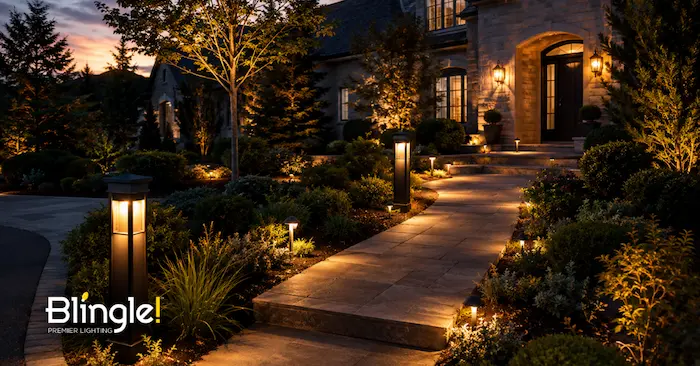

Post lights + tree uplights frame an entry or driveway with drama and depth. The upward wash of light on a mature tree alongside a post light creates a composition that looks professionally designed — because it is.
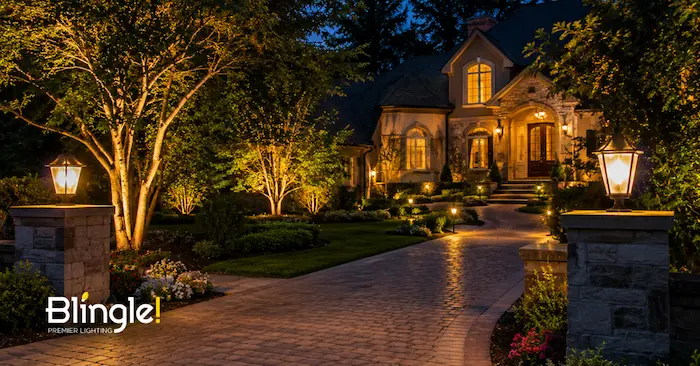
Post pair at the driveway + roofline accents brings symmetry to the whole front elevation. The vertical post lights at grade level echo the horizontal line of the roofline lighting above, tying the exterior together as a unified composition. Check out Blingle's photo gallery for real-world examples of these combinations in action.
For homeowners interested in a fully integrated, permanent system, Blingle's permanent lighting solutions and expert tips for permanent outdoor lighting are a great next step. Or, if you’re ready to get started, call us for a free consultation!
5 Tips to Pick and Place Your Post Lights
Choosing the right outdoor post light fixture involves more than grabbing whatever looks good at the hardware store. Style, scale, spacing, brightness, power source, and controls all interact — and getting any one of them wrong can undermine an otherwise beautiful installation. A lighting professional can help you navigate every variable, but these five tips will get you oriented.
1. Match the Style to Your Home's Architecture
The head style of a post light should feel like it belongs to your house, not like a fixture that was placed nearby it. Here's a quick matchmaking guide:
Lantern and coach-style heads — with seeded or clear glass panels and visible filament-style LEDs — suit traditional, craftsman, and colonial homes. They're the most timeless option and age gracefully alongside mature landscaping.
Modern cylinder and box heads — with clean geometric lines, frosted diffusers, and downlight optics — complement contemporary and transitional homes. They provide excellent light control with minimal visual clutter.
Globe and acorn heads — the classic street-lamp aesthetic — work beautifully on heritage and Victorian-influenced homes with larger front setbacks. Their wider profile fills a bigger visual space.
Pier-mount cube fixtures — compact, shrouded, with directed optics — are ideal for modern coastal and minimalist homes where controlling light spill toward neighbors matters.
Pro tip: Match your post light finish to your door hardware, roof gutters, or window trim. A matte black post light pairs perfectly with black window frames; oil-rubbed bronze complements warm-toned brick and craftsman trim. The cohesion makes the whole exterior feel considered.
By mount type:
In-ground posts set in concrete footings are the standard for freestanding installations (in cold climates, they must go below the frost line to prevent heaving).
Pier-mount fixtures adapt to existing masonry columns and deck piers.
Wall-top or cap-mount fixtures work on short masonry walls or entry pillars where a full post simply won't fit.
2. Get Spacing and Height Right
Mount height for residential post heads should fall between 6 and 7.5 feet — tall enough to cast light downward onto a path or drive, but not so low that the fixture itself sits at eye level and creates glare. Set posts back from the edge of paved surfaces to avoid both glare into oncoming vehicles and damage from lawn equipment.
For driveway edges, spacing post lights every 8–10 feet per side maintains consistent illumination without a runway effect. For walkways, alternate sides every 8–12 feet depending on fixture spread and lumen output.
3. Get the Brightness and Color Right
For ambient path and perimeter lighting, 450–900 lumens per head is the right range — bright enough to be useful, soft enough to feel residential rather than institutional. Driveway entries and larger property setbacks benefit from the higher end of that range or slightly above.
Color temperature makes an equally big difference in the feel of the result. 2700–3000K produces warm white light — inviting, flattering to landscaping, and consistent with the glow of a lit home. 3000–3500K reads slightly crisper and works well for paths and security-focused placements where visibility is the priority.
Look for fixtures with diffused optics for ambient settings and cut-off shields for locations near neighbors or the street, where controlling light spill keeps your lighting upgrade from becoming someone else's annoyance.
All outdoor fixtures should be wet-rated for exposure to the elements. In coastal or high-humidity climates, specify marine-grade brass or powder-coated aluminum to resist corrosion and salt air.
4. Choose Your Power Source
Line voltage (120V) is the gold standard for driveway entries and primary post light installations. It delivers consistent, high-output illumination regardless of weather or season, and it opens up the widest range of fixture styles. The trade-off: it requires licensed installation, trenching for conduit, and GFCI protection — all of which are good reasons to work with a professional.
Low voltage (12V) is a strong choice for path lighting and garden-adjacent installations. It's safer to expand over time, energy-efficient, and more flexible in layout. You'll need a transformer sized to your total load, and longer runs require voltage drop planning to maintain consistent brightness across all fixtures.
Solar is suitable for quick accent placements in sunny yards where you want the look without any wiring. It's not the right choice for primary driveway or entry lighting — output and consistency suffer in winter months and shaded locations.
5. Add Smart Controls
Photocell sensors are the most practical control for post lights: they turn on at dusk and off at dawn automatically, with no input needed. Set it and forget it.
Smart switches and timers let you add scheduling, vacation mode (randomized on/off patterns that simulate occupancy), and scene control — all from your phone. Lighting personalization and scene control is now used by 44% of new homebuyers, making smart-enabled fixtures an increasingly standard expectation.
Low-voltage zone dimming lets you adjust brightness across different areas of your landscape independently — dimming the path lights while keeping the driveway entry at full output, for example.
Pro vs. DIY: When to Call the Pros
Some post light work genuinely is DIY-friendly. Swapping a fixture head on an existing post, upgrading to an LED bulb, adding a photocell adapter to an existing socket, or repainting a weathered post can all be weekend projects with basic tools.
But several scenarios call strongly for professional installation:
New line-voltage runs require licensed electrical work, trenching, conduit, and GFCI protection — any of which done incorrectly creates both safety hazards and code violations
Frost-line footings in cold climates need to be dug and poured to the correct depth or post heaving will cause failure within a season or two
HOA and permit compliance — many jurisdictions and neighborhoods have specific requirements for exterior fixture placement, height, and light spill that professionals navigate routinely
Coordinated design across post lights, path lights, uplights, and roofline accents requires a system-level view that accounts for transformer load, voltage drop, fixture spacing, and visual balance
Smart integration into existing home automation systems (Alexa, Google Home, Control4) is straightforward for professionals and frustrating for DIYers unfamiliar with the protocols
Blingle's design team handles all of the above — and brings a whole-property perspective that ensures your post lights work with your existing landscape lighting rather than competing against it. Find a Blingle location near you to get started. Or give us a call for a free consultation.
Frequently Asked Questions About Outdoor Post Light Fixtures
Can outdoor post lights attach to a structure?
Yes. Some post lights are freestanding and installed in the ground, while others mount to masonry columns, deck piers, walls, or pillars. The best mounting option depends on your property layout and installation surface.
Do post lights attract bugs?
They can, but warm white LEDs (2700–3000K) attract fewer insects than cooler blue-toned lights. Fixtures placed farther from seating areas also help reduce bugs. Amber LEDs are another low-attraction option.
How bright should post lights be?
Most residential post lights work well between 450–900 lumens. Driveway entrances may benefit from slightly brighter fixtures. Avoid overly bright lighting, which can create glare and unnecessary light spill.
How do I prevent light spill into neighboring properties?
Choose fixtures with downward-facing or shielded lighting. Positioning lights inward toward your property also helps reduce glare and unwanted light spread.
Do LED post lights use a lot of energy?
No. LED post lights are highly energy efficient, typically using only 8–15 watts per fixture. They also last significantly longer than traditional incandescent bulbs.
Can post lights be put on a timer?
Yes. Many post lights work with photocells, timers, and smart home systems for automatic scheduling and dusk-to-dawn operation.
When You're Ready for Professional Installation, Keep Us Posted
The right outdoor post light fixtures — placed correctly, spec'd for your home's architecture, and integrated with the rest of your exterior lighting — are one of the fastest ways to modernize a property's nighttime presence and daytime look. The details matter: fixture style, mounting height, lumen range, color temperature, power source, and controls all interact to determine whether your post lights look like a designed system or an afterthought.
Blingle's lighting designers bring a whole-property perspective to every project — ensuring your post lights work in harmony with landscape lighting, permanent fixtures, and smart controls for a result that looks as good from the street as it does up close.
Ready to get started? Call a Blingle lighting designer today for a personalized consultation — or contact us online and we'll be in touch. Find your nearest Blingle location here.