

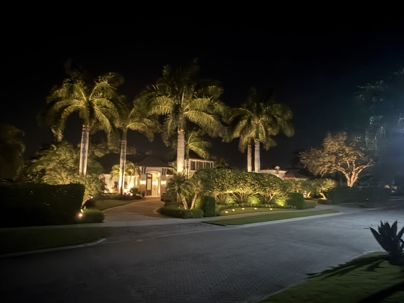
Fort Myers homes are built for outdoor living. The lanai, the pool deck, the waterfront dock, the front elevation that catches the last of the Gulf light every evening. But once the sun goes down, most of that investment disappears into the dark. A single porch light doesn't fix that. Neither does a floodlight that blinds everyone standing near it.
Permanent LED lighting changes the equation entirely. Rather than patching darkness with one harsh fixture, a professionally designed permanent system layers light across every surface that matters: rooflines, soffits, pathways, patios, and architectural details. The result is a home that looks intentional at night, functions safely after dark, and creates the kind of outdoor atmosphere that extends your living space well past sunset.
This guide covers exactly how permanent lighting from Blingle Premier Lighting delivers on three specific outcomes Fort Myers homeowners and residents across Lee and Collier County care about most: nighttime visibility, evening ambiance, and glare control. Each one deserves more than a surface-level answer.
Nighttime Visibility: Safety That Doesn't Look Like a Parking Lot
Most conversations about outdoor lighting safety default to floodlights and motion sensors. Those tools have their place, but they solve the wrong problem for a Fort Myers home. The real visibility challenge isn't about flooding a yard with raw lumens. It's about consistent, predictable illumination across the areas where accidents and security risks actually occur.
Well-lit properties are up to 30% less likely to be targeted by burglars, according to research cited across residential safety studies. But the more immediate risk for most homeowners isn't crime. It's the everyday hazards: a misstep on an unlit stair, a guest who can't find the path to the front door, a driveway that goes completely dark after 8 PM.
Where Visibility Gaps Create Real Risk
The most dangerous spots on a Fort Myers property at night are predictable:
Entry steps and level changes near the front door, lanai access, and pool deck edges
Driveway edges and turns, especially on longer or curved driveways
Walkway transitions between hardscape and landscaping
Dock access and waterfront areas, where a misstep has more serious consequences
A permanent lighting system addresses each of these zones with fixtures designed specifically for that surface. According to IES guidelines for residential exterior lighting, entry areas and task zones should achieve 100 to 300 lux for reliable safety, while general façade and wayfinding areas fall in the 50 to 150 lux range. Professional installation places fixtures to hit those targets without over-illuminating, which is where glare problems begin.
The Consistency Advantage
Temporary lighting solutions, whether seasonal strings or standalone fixtures added over time, create uneven coverage. Bright spots next to dark gaps are actually more disorienting than uniform low light, because the eye can't adjust between the two. Permanent systems are designed from the start for continuity: every pathway lit, every edge defined, every approach to the home visible from the street.
For Fort Myers homeowners with security cameras, consistent illumination is also a practical necessity. Cameras require adequate, even light to capture usable footage. A permanent system that keeps key areas lit all night provides the baseline those cameras need to function.
Ambiance: Turning Outdoor Spaces Into Evening Destinations
Fort Myers has one of the most outdoor-oriented lifestyles in Florida. Lanais, pool areas, and backyard entertaining spaces aren't seasonal amenities here. They're used year-round. The problem is that most homes treat these spaces as daytime-only assets. Once the sun sets, the atmosphere collapses.
Permanent LED lighting solves this by creating a layered light environment that doesn't just illuminate, it transforms. There's a meaningful difference between a patio that's "lit enough to see" and one that genuinely draws people outside at night. The latter requires intentional design.
How Layered Lighting Creates Atmosphere
Professional lighting designers work with three distinct layers to build ambiance in outdoor spaces:
Layer | Purpose | Common Placement |
Ambient | Overall brightness and orientation | Roofline LEDs, soffit lights, string canopy |
Accent | Highlight architectural or landscape features | Uplights on palms, wall grazing on stone |
Task | Functional illumination for specific activities | Step lights, countertop lighting, grill area |
When all three layers work together, the result is depth. The eye moves across the space naturally, picking up the texture of a stone wall, the silhouette of a palm, the warm glow of a seating area. When only one layer exists, the space looks flat and institutional regardless of how many lumens are present.
Color Temperature Matters More Than Brightness
One of the most overlooked elements of outdoor ambiance is color temperature. WELL v2 building standards recommend warmer color temperatures in the evening (2700 to 3000K) to support relaxation and avoid the harsh, bluish cast associated with cooler LEDs. For a Fort Myers lanai or pool deck, this means the difference between a space that feels like a resort and one that feels like a convenience store parking lot.
Blingle's permanent lighting systems use app-controlled RGB LEDs, which means homeowners can dial in the exact color temperature and intensity for any occasion. Dinner on the lanai calls for warm, low-level ambient light. A holiday gathering might use a festive color scheme. A quiet evening by the pool benefits from a soft, dim setting. One system handles all of it without any rewiring or fixture swaps.
The practical upside: the National Association of Realtors' Remodeling Impact Report found that homeowners recover an average of 59% of their landscape lighting investment at resale, making ambiance-focused outdoor lighting one of the better-performing home improvement categories.
Glare Control: The Problem Most Homeowners Don't Know They're Creating
Glare is the most common self-inflicted mistake in residential outdoor lighting. A homeowner installs bright fixtures to improve visibility or security, and the result is the opposite: harsh light that causes eye strain, washes out the surrounding space, and creates dark shadows directly adjacent to the bright source. Anyone who has tried to navigate a driveway lit by a single overhead floodlight understands the problem immediately.
The core issue with glare: when a light source is visible at eye level or directed outward rather than toward a surface, the human eye can't adjust. The fixture becomes the focal point instead of the space being illuminated.
What Professional Glare Control Actually Looks Like
Certified lighting designers use several techniques to eliminate glare before it becomes a problem:
Fixture angle: Recessing LEDs beneath soffit edges and angling them 15 to 30 degrees toward the façade keeps the light source out of the line of sight while still illuminating the surface
Brightness ratios: A 3:1 highlight-to-base brightness ratio provides enough contrast to define architectural details without creating harsh edges or blinding spots
Diffusers: Placed over bright LED strips, diffusers soften hotspots and distribute light more evenly across a surface
Zone dimming: App-controlled systems allow different zones to operate at different brightness levels simultaneously, so a brightly lit entry doesn't blow out the softer pool area nearby
The result is what lighting professionals call "visual comfort." The space is well-lit, but no single fixture demands your attention. You see the home, the landscape, the outdoor living areas. Not the bulbs.
Why This Matters Specifically in Fort Myers
Southwest Florida's outdoor lifestyle means more time spent in those illuminated spaces, not just passing through them. A lanai with glare-heavy lighting isn't a place anyone wants to linger. A pool deck where the lights reflect harshly off the water creates eye fatigue rather than relaxation.
Glare also affects neighbors and the street view. A well-designed permanent system keeps light on the property where it belongs. Fixtures aimed at the façade, downlights on pathways, and zone-controlled accents mean the home looks polished from the street without casting unwanted light into adjacent yards.
For homeowners in HOA communities or gated neighborhoods across Lee and Collier County, this distinction matters. Thoughtful glare control keeps a home compliant with community standards while still achieving a premium nighttime appearance.
Explore the full range of landscape lighting options and patio and lanai lighting that Blingle designs for Fort Myers properties.
Why Permanent Lighting Outperforms Temporary Solutions Year-Round
Seasonal lighting and DIY fixture additions solve isolated problems temporarily. A permanent system solves all three problems, visibility, ambiance, and glare, simultaneously and consistently. The comparison isn't close once you factor in the full picture.
Factor | Temporary/DIY Lighting | Permanent Professional System |
Coverage | Spot-based, uneven | Full-property, designed for continuity |
Glare control | Rarely considered | Engineered into fixture placement |
Color/dimming control | Fixed or manual | App-controlled, scene-based |
Weather durability | Variable (IP ratings often unknown) | IP65-IP67 rated for Florida conditions |
Lifespan | 1,000 to 5,000 hours typical | Up to 50,000 hours for quality LEDs |
Seasonal flexibility | Requires physical changes | Color and scene changes via app |
For Fort Myers homeowners, the weather durability point is particularly relevant. Southwest Florida's combination of intense sun, high humidity, salt air near the coast, and hurricane-season wind loads is genuinely hard on outdoor fixtures. Systems rated IP65 or higher handle rain, moisture, and heat without performance degradation. Fixtures that aren't rated for those conditions will fail within a season or two.
Blingle's permanent lighting systems are installed by certified designers who account for all of these environmental factors before a single fixture goes up. The free design consultation includes a property walkthrough to assess exposure, architectural features, and the specific zones where visibility, ambiance, and glare control need to be balanced.
The Year-Round Value Proposition
One of the most compelling aspects of permanent lighting for Fort Myers homeowners is the seasonal flexibility built into the system. The same roofline and soffit LEDs that provide warm white ambient light on a typical Tuesday evening can shift to holiday colors for Thanksgiving, Christmas, or the Fourth of July. No ladders, no temporary installs, no storage. One app, one system, every occasion.
This is what separates a well-designed permanent system from any other outdoor lighting approach. It isn't a single-purpose fixture. Its infrastructure for the entire outdoor experience of the home, every night of the year.
View Blingle's permanent lighting gallery to see how these systems look on homes across Fort Myers, Naples, Cape Coral, and the surrounding Lee and Collier County area, then book a free consultation to get a custom design for your property.