


Backyard Lighting Ideas to Turn Your Patio Into a Nighttime Hangout with Outdoor Patio Lighting Solutions

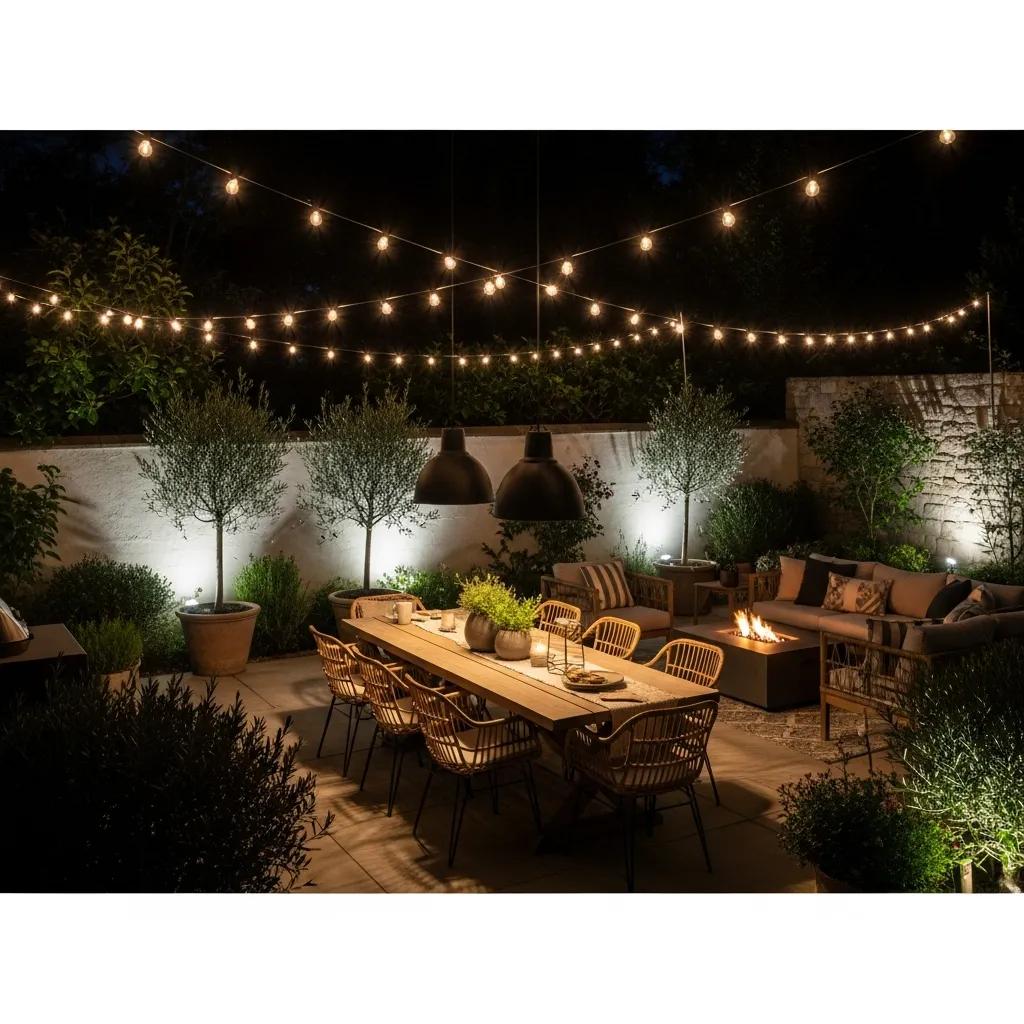
A well-designed backyard lighting plan transforms a patio from a daytime feature into an evening living room, extending usable hours and improving both ambiance and safety. This guide teaches practical patio lighting ideas, layering strategies, energy-efficient technologies, and when to hire a professional so you can create a reliable nighttime hangout. You'll learn specific fixture recommendations—from string lights and pendants to LED uplights and path lights—along with placement rules and lumen guidance to balance mood with function. The article also compares LED, solar, and low-voltage systems, shows how to layer ambient, task, and accent lighting, and explains how professional services can simplify installation and maintenance. Follow these step-by-step ideas, check the example tables and lists, and use the visualization and design guidance here to plan a patio that looks great and performs safely for year-round use.
What Are the Best Outdoor Patio Lighting Ideas to Create Ambiance and Functionality?
Ambient, task, and accent lighting are the foundation for patio ambiance and practical use, and several fixture types cover those needs efficiently. The best ideas blend soft, warm sources for mood with brighter, focused fixtures for dining and circulation, ensuring the space is both inviting and usable. Thoughtful placement—over a dining table, around seating groups, and along walkways—creates distinct zones that serve different activities while tying the scene together visually. Below are high-impact ideas to spark a plan you can execute yourself or refine with a designer.
This short list highlights top ideas and their core benefit for quick planning:
Bistro-style string lights: Create warm, even ambient glow over dining and lounge areas.
Pendant or chandelier over table: Provide focused task lighting for meals and games.
LED uplights for trees or architecture: Add depth and highlight focal points at night.
These three starter ideas combine atmosphere and function and serve as building blocks for layered lighting setups. The next subsections break down string-light strategies and landscape lighting options so you can apply these concepts to your patio layout.
How Do String Lights Enhance Patio and Backyard Ambiance?
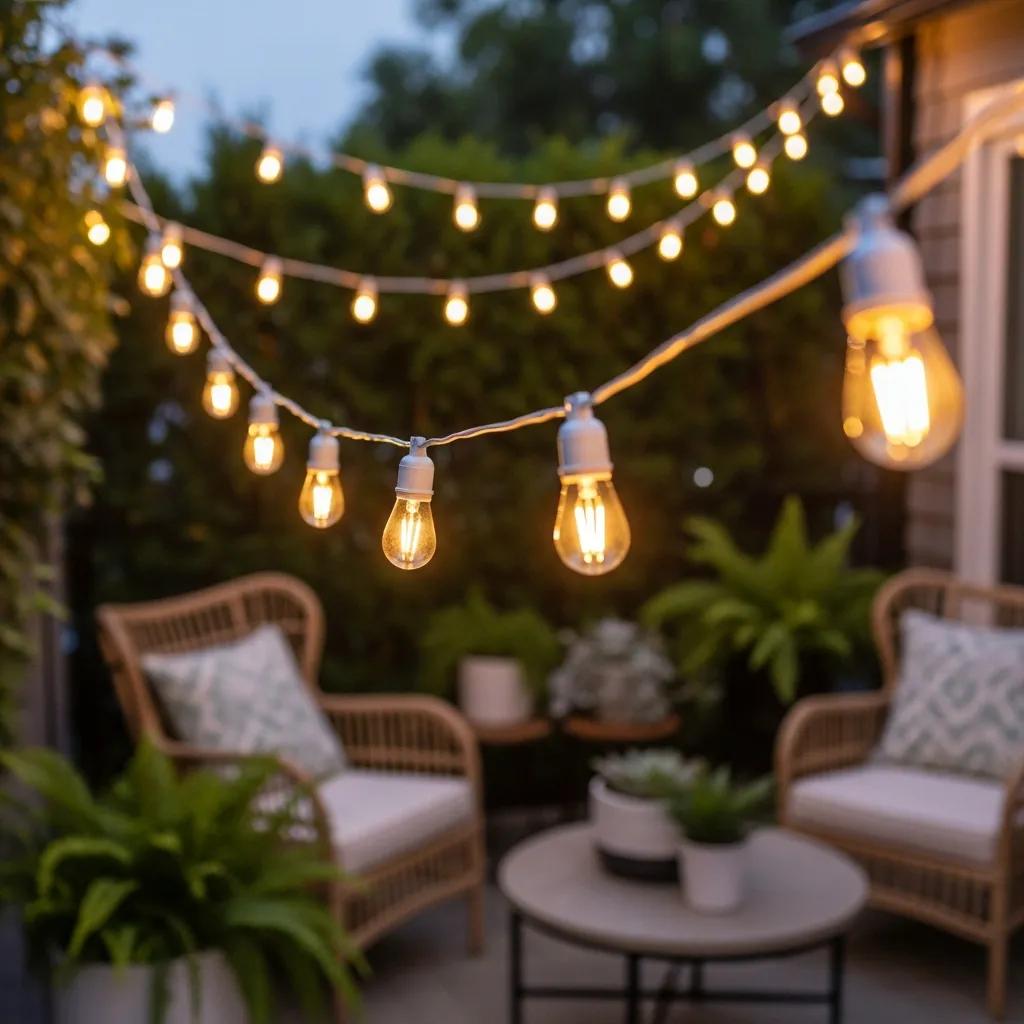
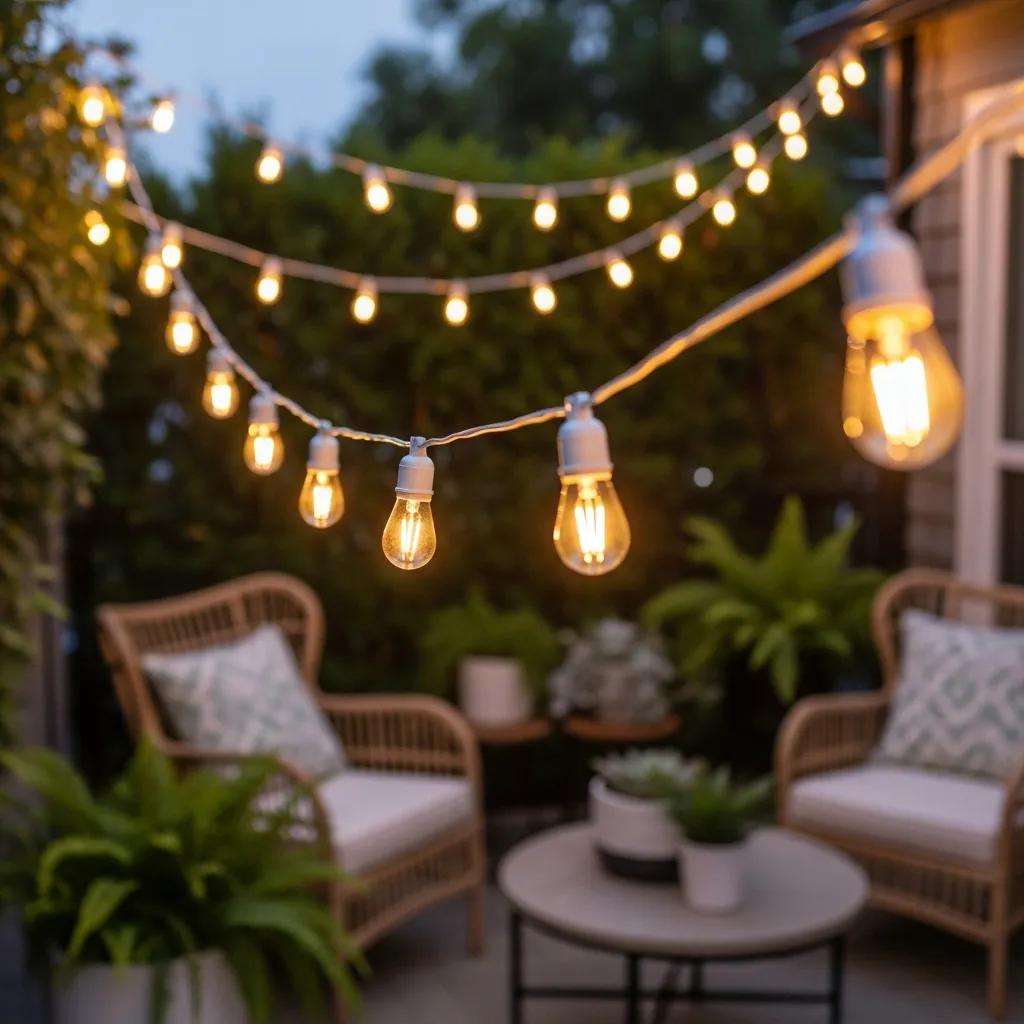
String lights are a simple ambient solution that lowers perceived contrast and produces a cozy, social atmosphere by distributing soft, warm illumination across a space. Their mechanism is straightforward: spaced bulbs at warm color temperatures reduce harsh shadows and create a continuous field of light that signals a dedicated activity zone, which improves comfort and usability. For different aesthetics, choose among globe bistro string lights for classic dining scenes, fairy lights for delicate overhead washes, or Edison-style bulbs for a vintage look; each type brings distinct texture to the environment. When installing, aim for even spacing and tensioned runs anchored to secure points like pergola beams or purpose-built posts; this ensures durability and an even light pattern. Good string-light planning also anticipates power routing, transformer sizing for long runs, and weather-rated fixtures to protect electrical components.
What Landscape Lighting Options Improve Patio Safety and Aesthetics?
Landscape lighting choices—uplights, spotlights, path lights, and in-ground well lights—serve both to accent features and to make transition zones safer at night by increasing visibility where people walk. Uplighting uses narrow beams and sits several feet from a tree or wall to create dramatic silhouettes and reveal texture, while spotlights provide directional emphasis on statues or specimen plants. Path lights and low-profile step lights reduce trip hazards by defining edges and providing consistent lumen levels across walking surfaces; generally target lower lumen values for path lights to avoid glare and higher CRI LEDs near plantings to preserve color fidelity. Placement rules include positioning uplights at a distance roughly 1/3 to 1/2 of a feature’s height to avoid flattening, and spacing path lights every 6–10 feet depending on their lumen output and beam spread. These principles keep the yard readable at night, and they transition naturally to layering techniques for a cohesive patio lighting plan.
How Can You Layer Backyard Lighting for a Cozy and Inviting Nighttime Hangout?
Layered lighting combines ambient, task, and accent sources so the patio supports multiple activities and reads naturally at night; this layering creates a hierarchy of light that guides the eye and activity. Ambient lighting establishes the overall mood, task lighting supports specific functions like cooking or dining, and accent lighting highlights architectural or garden features. Proper layering reduces the need for a single, overly bright source and improves energy efficiency while enhancing visual comfort. The following table maps each layer to its purpose and common fixtures so you can plan a balanced system.
| Layer | Purpose | Common Fixtures and Examples |
|---|---|---|
| Ambient | Set overall mood and uniformity | String lights, overhead pendants, porch sconces |
| Task | Provide bright, focused light for activities | Pendant over dining table, under-counter grill lights |
| Accent | Highlight features and add depth | LED uplights, spotlights, small well lights |
This matrix clarifies where to place each fixture type and how layers work together; ambient sources create the base, task lights bring usable illumination, and accents add drama and depth. The following subsections define the layers and give practical tips for choosing fixtures and styles to support your patio's architecture and activities.
What Are the Differences Between Ambient, Task, and Accent Lighting?
Ambient lighting provides broad, low-contrast illumination to establish mood and circulation paths, task lighting delivers concentrated light for specific activities like chopping or reading, and accent lighting focuses attention on objects or textures to create depth. Mechanistically, ambient lights reduce brightness variance across the space, task fixtures increase localized lumen density for safety and function, and accent sources shape three-dimensional perception through contrasts and highlights. For lumen guidance, aim for 100–300 lumens for table task lights and 20–60 lumens for individual path lights depending on beam and spacing; color temperature between 2700K–3000K tends to preserve warm ambiance while maintaining accurate color rendering. Selecting fixtures by IP rating and beam spread ensures durability and appropriate light distribution for each role. Understanding these differences helps you prioritize fixture choice and placement for each patio zone.
The advancements in LED technology have significantly impacted general lighting applications, offering superior performance and innovative capabilities.
LED Lighting: Performance, Innovation, and Emotional Content In 2018, Solid-State Lighting (SSL) can totally outperform, if properly designed, most of other lighting products used for general lighting applications. This concerns various attributes such as luminous efficacy, life, spectral qualities, dimming potential, and more and more total cost of ownership. SSL can also mimic a large variety of reference light sources from candlelight to sunlight. The absence of international standards concerning LED modules remains the major difficulty for luminaire manufacturers and their clients, since perfectly matching replacement of ever-changing LED modules is not guaranteed over time. But extraordinarily innovative lighting schemes can be developed, bridging the gap between the world of entertainment and the world of general lighting, and leading to new lighting schemes with more powerful emotional content. LED lighting, ultra-low-power lighting schemes for new lighting applications, 2018
How Do You Choose the Right Fixtures and Styles for Your Patio Lighting?
Choosing fixtures requires balancing aesthetic style, material durability, and technical specifications such as IP rating and beam angle so the lights perform reliably outdoors. Begin with the patio’s architectural style—modern materials like matte black metal and linear LEDs suit contemporary designs, while lanterns and warm-glass pendants complement rustic or coastal themes—and then match scale so fixtures are proportional to furniture and ceiling height. For longevity, select outdoor-rated finishes and IP65 or higher for fixtures exposed to rain and irrigation, and specify LED modules with drivers suited for outdoor temperatures to avoid premature failure. Finally, consider components such as bulbs, mounting hardware, and transformers when designing a low-voltage system; specifying the right parts ensures compatibility and simplifies maintenance. These selection steps set up a system that looks cohesive and performs well over time.
Which Energy-Efficient and Smart Lighting Solutions Are Ideal for Patios and Backyards?
Energy-efficient options like LED and quality solar lighting significantly reduce power draw and maintenance compared with traditional halogen while offering better color rendering and longer lifespans. Smart controls add convenience through scheduling, scenes, and remote access, and they reduce waste by zoning lights and using automation when areas are unoccupied. Maintenance demands, upfront costs, and installation complexity differ between LEDs, solar fixtures, and low-voltage halogen systems, so comparing attributes makes the right choice for a given site and budget. The table below compares these technologies across key attributes to make selection easier.
| Technology | Energy Use & Lifespan | Upfront Cost & Installation | Maintenance & Notes |
|---|---|---|---|
| LED (luxury-grade) | Very low energy, 25,000–50,000+ hours | Moderate to higher upfront, professional wiring often recommended | Low maintenance, high CRI options available |
| Solar (quality units) | Zero grid use, lifespan 5–15 years | Low upfront, simple retrofit installation | Performance varies by sun exposure; battery maintenance required |
| Low-voltage halogen | Higher energy, shorter lamp life | Lower lamp cost but higher energy bills | More frequent bulb changes and transformer considerations |
This comparison highlights that luxury LED systems deliver the best combination of efficiency, color rendering, and long-term value while solar offers easy retrofit options for lower-use areas. After considering these trade-offs, a professional can recommend the correct LED drivers, transformer sizing, and solar battery capacity for your layout.
Blingle! is a premier outdoor lighting service provider offering design, installation, and maintenance, and their offerings align with these energy-efficient choices. Their visualization technology helps clients preview luxury LED and solar schemes before installation, enabling accurate decisions about color temperature, fixture placement, and driver selection. Because luxury LED fixtures and high-quality solar components have different installation needs—such as heat management, driver integration, or battery placement—professional implementation often yields better longevity and aesthetic results. Mentioning this choice here leads into how professional design streamlines both selection and long-term support.
Despite their advantages, the widespread adoption of LEDs in contemporary lighting design has faced challenges related to photometry, colorimetry, and standardization.
LED Lighting Design: Challenges and Technological Advancements Lighting Emitted Diodes (LEDs) are currently being used in advanced lighting designs, mainly in the leisure industry, due to the technological advantages that they offer. Nevertheless, there have been key problems related to the adoption of LEDs in contemporary lighting design schemes. These include the photometry and colorimetry of LEDs, the limited available standards against which to compare and evaluate LEDs, the inadequacy of uniform definitions, and also the lack or inconsistency of data in the LED supply chain. In light of the above, the thesis aims at examining the implications of using LEDs in the illumination of the leisure industry, given the latest technological advancements. Lighting Design with LEDs: An investigation of the information that lighting designers require and receive from the LED Supply Chain, and an empirical study on the …, 2016
What Are the Benefits of Luxury LED and Solar Lighting for Outdoor Spaces?
Luxury LED lighting combines low energy use with long lifespans and excellent color rendering (high CRI), which preserves plant and material tones and reduces replacement cycles. The mechanism is semiconductor efficiency and stable light output, which translates into predictable light levels and minimal lumen depreciation over time, making LED attractive for permanent patio installations. Solar fixtures are advantageous for retrofit projects or areas without easy wiring; they eliminate grid electricity for specific nodes but depend on consistent sun exposure and quality battery systems for reliability. Choosing luxury LED for primary zones and solar for secondary or decorative elements often gives the best balance of performance and cost-effectiveness. Smart controls and proper drivers enhance these technologies by preventing overuse and enabling scene-setting for entertaining and security.
How Does Smart Outdoor Lighting Enhance Control and Convenience?
Smart outdoor lighting systems give granular control through scheduling, zones, and scene presets, which improves convenience and allows energy savings by powering only the zones needed for an activity. Features like geofencing, remote access, and scene-based automation create a seamless user experience for entertaining or security, and integration with popular voice ecosystems makes routine adjustments effortless. Interoperability considerations include communication protocols and standards such as Wi-Fi, Zigbee, or Matter support to ensure devices work together reliably across controllers and apps. Smart diagnostics and remote monitoring can also reduce maintenance by flagging lamp failures or driver-voltage issues before they become visible. These control capabilities make it easier to run an energy-efficient, well-orchestrated outdoor lighting scheme.
Why Should You Consider Professional Patio Lighting Design and Installation?
Professional design and installation reduce the risks of improper wiring, insufficient waterproofing, and poor fixture placement that can compromise safety and longevity; professionals also ensure code compliance and optimized performance. Designers translate layered lighting concepts into a coordinated plan that balances lumens, beam angles, and fixture scale while aligning with the property’s architecture and landscape. Professionals can also manage component selection—drivers, transformers, and outdoor-rated fixtures—and provide documentation for maintenance, which yields long-term cost savings through fewer repairs and replacements. Below are concrete reasons to hire a pro rather than attempting complex installations alone.
Key advantages of professional services include:
Safety and code compliance: Professionals follow electrical standards and ensure GFCI protection and correct wiring.
Customized design: Layered, balanced lighting plans that avoid glare and uneven illumination.
Warranty and aftercare: Maintenance plans and guarantees that protect your investment.
These benefits make professional engagement attractive for permanent luxury LED systems and complicated runs, and the next subsection explains how Blingle!’s tools support the design process.
How Does Blingle!’s Custom Design and Visualization Technology Work?
Blingle! uses visualization technology to show clients accurate previews of proposed lighting schemes on their properties, allowing design choices to be tested before any installation work begins. The process typically starts with a consultation to understand the site, desired scenes, and activity zones, proceeds to a rendered plan that illustrates fixture types, placements, and color temperatures, and then allows iterative revisions so the client can refine aesthetics and functionality. Visualization reduces uncertainty by making fixture scale and light distribution visible, which helps finalize decisions about luxury LED versus solar options and smart control zoning. Offering this clarity up front shortens decision cycles and leads to installations that meet both aesthetic goals and practical requirements, which transitions into the operational advantages of professional installation and maintenance.
What Are the Advantages of Professional Installation and Maintenance?
Professional installation ensures correct system wiring, suitable mounting hardware, and proper driver or transformer integration, which prevents early failures and safety problems while optimizing light output. Maintenance programs and worry-free guarantees shift long-term risk from the homeowner to the provider, reducing unexpected repair costs and keeping scenes consistent over time through scheduled checks and component replacements. Professionals also document system components and settings for easier troubleshooting and future upgrades, which preserves the value of the lighting investment. These advantages of installation and aftercare make professional services particularly valuable for multi-zone smart systems and permanent luxury LED installations.
What Are Creative Backyard String Light Ideas to Transform Your Patio?
Creative string light treatments turn ordinary patios into memorable nightscapes through patterns, densities, and combinations with structure, and they work well for both intimate gatherings and larger social events. Overhead canopies, zig-zag runs, tree-wrapping, and pergola-integrated strings each produce different visual densities and atmospheres; selecting the right pattern depends on ceiling height, furniture layout, and desired intimacy level. Combining string lights with accent uplighting on nearby trees or planters adds depth and reduces the feeling of suspended darkness beyond the lit area. Below are practical ideas to visualize and implement dramatic string-light layouts.
Popular creative string-light concepts include:
Overhead canopy: Dense grid for an intimate, covered feel.
Zig-zag runs: Lighter coverage that reads airy and festive.
Pergola-integrated wiring: Built-in channels for semi-permanent, weatherproof installations.
These approaches vary in installation complexity and durability, which leads naturally into guidance about anchor hardware, spacing, and when to opt for professional installation.
How Can You Use Overhead String Light Canopies and Pergola Lighting?
Overhead canopies create an immediate sense of enclosure and are anchored between secure points such as house eaves, posts, or pergola rafters, while pergola lighting leverages built-in structure for concealed wiring and cleaner power routing. Best practice is to use stainless-steel hardware or rated tensioning kits for long runs, maintain even bulb spacing for consistent luminous coverage, and consider transformer placement for long continuous runs to avoid voltage drop. For pergolas, route power through dedicated conduits and choose outdoor-rated fixtures with appropriate IP ratings to protect against moisture. Planning anchor points and service access during installation makes later maintenance and seasonal changes straightforward, and complex or permanent canopy systems are prime candidates for professional installation to ensure longevity.
What Are Budget-Friendly DIY String Light Installation Tips?
DIY string-light projects can be safe and attractive if you choose outdoor-rated products, protect electrical connections, and use appropriate anchors for your expected load and weather conditions. Start with weatherproof-rated string lights and simple anchors like cup hooks for temporary runs, upgrade to lag-screw eye bolts for semi-permanent installs, and always plug into GFCI-protected circuits; these choices minimize risk and extend product life. Keep runs short or add adequately rated transformers to prevent dimming, and avoid overloading a single circuit by distributing loads or using smart plugs with load monitoring. For homeowners unsure about electrical details, a hybrid approach—DIY layout with professional final wiring—can combine savings with safety.
How Do Landscape and Path Lighting Solutions Enhance Patio Usability and Safety?

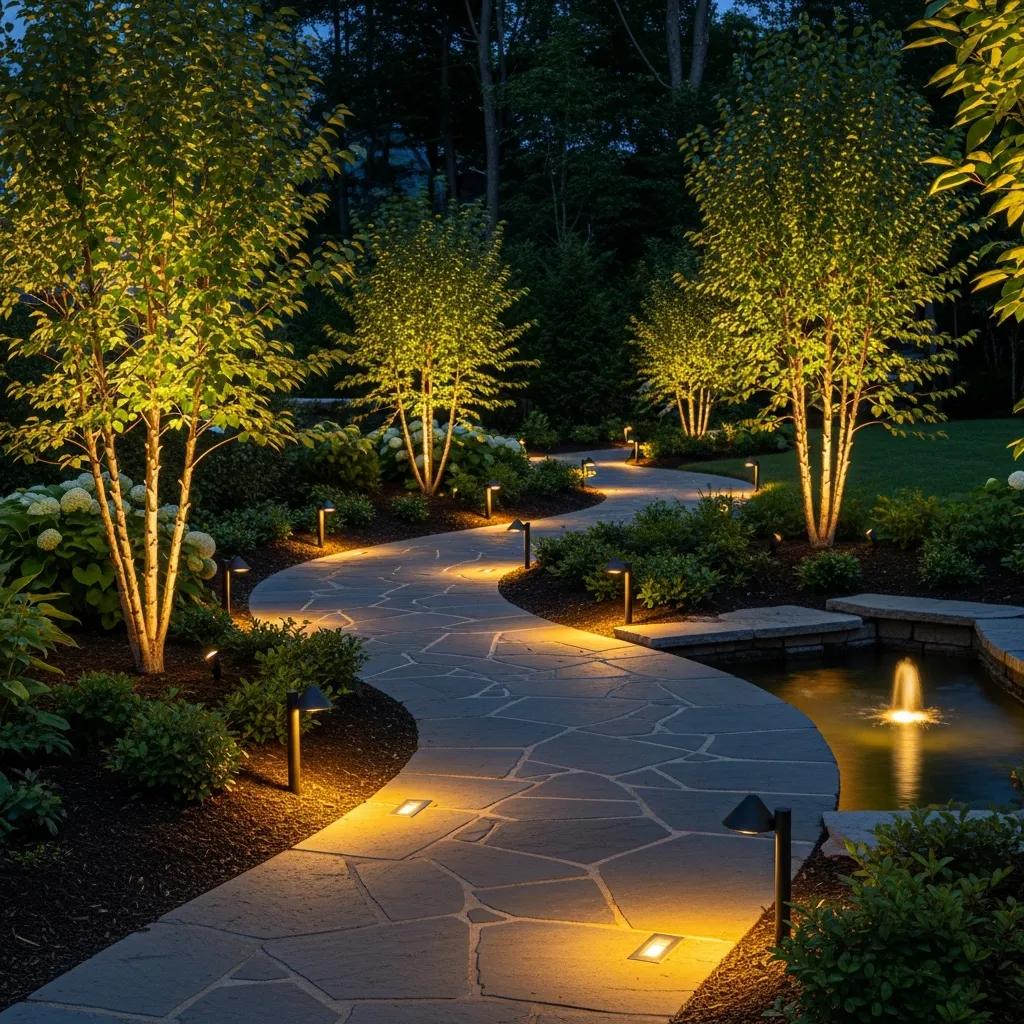
Landscape and path lighting increase patio usability by making routes and transitions visible, reducing the chance of trips and falls, and by spotlighting features that guide movement and frame outdoor scenes. Properly specified lumens, beam angles, and fixture placements deliver both functional illumination and sculptural effects on plants and architecture. Installation choices must match foot-traffic levels and ground conditions, using robust mounting for high-traffic zones and buried fixtures where appropriate to avoid hazards. The table below lists practical fixture recommendations for common path and step features to help make safer design choices.
| Feature | Recommended Fixture | Placement, Lumens & Notes |
|---|---|---|
| Straight path | Low-profile path lights | Mount 6–10 ft apart, 10–30 lumens each for even visibility |
| Steps | Recessed step lights or riser lights | Install on risers or nosing, 50–150 lumens, avoid glare |
| Edging and borders | Low-angle uplights or bollards | Use narrow beams to define edges without blinding pedestrians |
These recommendations ensure consistent brightness and reduce high-contrast transitions that cause visual discomfort, and they feed into targeted uplighting techniques for garden features discussed next.
What Are Effective Uplighting and Spotlights for Garden Features?
Effective uplighting positions fixtures at a calculated distance from the subject—often one-third to one-half of the feature’s height—to create flattering silhouettes and preserve texture without flattening shapes. Choose beam angles based on feature size: narrow (10°–25°) for tall, narrow trunks or spires, medium (25°–40°) for shrubs and medium features, and wider beams for walls or facades; these choices (fixture, beam, mount) determine the perceived depth. Use LED fixtures with high CRI where color accuracy is important, and avoid pointing uplights directly at human activity zones to prevent glare. Adjusting angle and intensity in small steps during installation produces the most natural and appealing results.
How Can Path and Step Lights Improve Backyard Safety at Night?
Path and step lights create uniform luminance across walking surfaces and edges, minimizing shadows and unexpected depth changes that can cause trips; regular spacing and correct lumen selection maintain sightlines at typical walking speeds. Rule-of-thumb spacing for path fixtures is 6–10 feet depending on fixture output and beam spread, while step lighting should be integrated into the step riser or installed slightly recessed to prevent glare and slippage. Choose durable, anti-slip materials around steps and position fixtures to avoid direct view into the eyes of users, combining these installations with ambient lighting to prevent stark brightness contrasts. When planned carefully, path and step lighting deliver measurable safety benefits and increase usable outdoor hours.
This article has mapped practical ideas, layering strategies, technology comparisons, and professional considerations so you can plan a patio that becomes a reliable nighttime hangout. Use the lists and tables above to prioritize improvements and to communicate clearly with designers or installers about desired outcomes and technical constraints. If you decide professional help is right for your project, Blingle! provides visualization-guided design, expert installation, and maintenance with worry-free guarantees to support long-term performance and enjoyment.
Frequently Asked Questions
What are the key considerations for outdoor lighting safety?
When planning outdoor lighting, safety is paramount. Ensure all fixtures are rated for outdoor use and comply with local electrical codes. Use GFCI outlets to prevent electrical shocks, and choose weather-resistant materials to withstand the elements. Proper placement of lights is crucial; avoid glare and ensure pathways are well-lit to prevent trips and falls. Additionally, consider the height and spacing of fixtures to create a balanced illumination that enhances visibility without overwhelming the space.
How can I maintain my outdoor lighting system?
Regular maintenance of your outdoor lighting system is essential for longevity and performance. Start by cleaning fixtures to remove dirt and debris that can block light output. Check for any damaged wiring or fixtures and replace them as needed. For solar lights, ensure the solar panels are clean and positioned for maximum sunlight exposure. Schedule periodic inspections to assess the overall condition of the system, and consider professional maintenance services for complex setups to ensure everything operates smoothly.
What are the benefits of using smart lighting controls for outdoor spaces?
Smart lighting controls offer numerous benefits for outdoor spaces, including enhanced convenience and energy efficiency. With smart systems, you can schedule lighting to turn on and off automatically, adjust brightness levels, and create customized lighting scenes for different occasions. Remote access allows you to control your lights from anywhere, providing added security. Additionally, smart lighting can integrate with home automation systems, enabling features like geofencing to turn lights on when you arrive home, enhancing both safety and comfort.
How do I choose the right color temperature for outdoor lighting?
Choosing the right color temperature for outdoor lighting is crucial for creating the desired ambiance. Warmer color temperatures (2700K-3000K) provide a cozy, inviting atmosphere, ideal for dining and relaxation areas. Cooler temperatures (4000K-5000K) are better suited for task lighting, such as cooking or working in the garden, as they enhance visibility. Consider the overall design and purpose of your outdoor space when selecting color temperatures to ensure a harmonious and functional lighting scheme.
What are some creative ways to use uplighting in my backyard?
Uplighting can dramatically enhance the aesthetics of your backyard by highlighting architectural features, trees, and garden elements. Position uplights at the base of trees to create striking silhouettes against the night sky, or use them to accentuate sculptures and water features. For pathways, uplights can define edges and create a sense of depth. Experiment with different beam angles and placements to achieve various effects, and consider using colored filters for a more dynamic visual impact.
How can I effectively integrate solar lighting into my outdoor design?
Integrating solar lighting into your outdoor design can be both functional and aesthetically pleasing. Start by selecting high-quality solar fixtures that match your design style. Place them in areas with ample sunlight exposure to maximize their efficiency. Use solar path lights to illuminate walkways and garden beds, and consider solar string lights for a festive touch. To enhance the overall look, combine solar lighting with other types of fixtures, ensuring a cohesive design that balances energy efficiency with visual appeal.
Conclusion
Transforming your patio with effective lighting solutions enhances both ambiance and safety, allowing for enjoyable outdoor experiences year-round. By understanding the principles of layered lighting and selecting the right fixtures, you can create a visually appealing and functional space. If you're ready to elevate your outdoor area, consider exploring professional services that can guide you through the design and installation process. Discover how Blingle! can help you achieve the perfect lighting setup for your patio today.