

Permanent outdoor lighting has moved well past holiday novelty. For Fort Myers homeowners and commercial property owners in Lee and Collier County, it has become a serious infrastructure decision, one that touches electrical systems, architectural design, smart home integration, and long-term property value.
The problem is that most of the information available online treats it as a simple product purchase. Pick a color, mount some lights, download an app. The reality of a professional-grade permanent lighting installation is considerably more involved, and the gap between a system that lasts 10 years and one that fades or fails in three comes down to decisions made before a single fixture is mounted.
This guide covers three things most buyers don't find in one place: the genuine installation challenges that separate professional work from DIY attempts, an honest cost breakdown with real 2025 data, and a clear-eyed look at the technology stack powering today's best permanent lighting systems.
Whether you're a homeowner looking to illuminate a waterfront property or a commercial operator wanting year-round architectural lighting for a storefront or hospitality space, this is what you need to know before committing to a system.
The Real Installation Challenges Nobody Talks About
Most prospective buyers focus on aesthetics: what color, how bright, which roofline. Those are valid questions, but they come second. The decisions that determine whether a permanent lighting system performs reliably for a decade are mostly invisible to the untrained eye, and they happen during the installation phase.
Roofline Complexity and Structural Access
A flat, single-story roofline is the easiest case. Fort Myers properties rarely offer that. Waterfront homes, Mediterranean-style architecture, multi-story structures with dormers, and commercial buildings with parapets all introduce complexity that directly increases labor time and material costs.
Every additional peak, valley, or architectural feature requires custom channel routing, additional mounting hardware, and more precise wire management. Industry installers estimate that each additional 10 feet of complex roofline adds $150 to $250 in labor alone, beyond the baseline linear footage cost. A home with multiple gables or a hip roof can see installation time double compared to a comparable straight-line property.
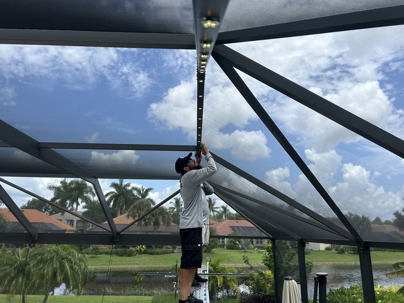
For Fort Myers properties with lanais, screened enclosures, docks, and pool decks, the challenge extends beyond the roofline. Each surface type requires different mounting solutions, and the proximity to water demands corrosion-resistant hardware throughout.
Electrical Load Planning and Circuit Capacity
This is where most DIY installations fail. Permanent lighting systems draw consistent electrical load, unlike seasonal lights that run for a few weeks. A full-perimeter installation on a standard home (150 to 200 linear feet) requires dedicated circuit capacity. High-current draw at switch-on, known as inrush current, can trip standard circuit breakers if the system is not engineered properly.
Professional installers assess:
- Existing panel capacity and available circuits
- Voltage drop over long cable runs (critical for larger properties)
- Load balancing across multiple zones
- Surge protection requirements, especially relevant in Southwest Florida's storm season
- Low-voltage vs. line-voltage system selection based on property scope
Skipping this assessment is the single most common cause of system failures and warranty voids in DIY permanent lighting installs.
Florida's Climate: A Unique Installation Variable
Fort Myers sits in a subtropical climate with intense UV exposure, high humidity, salt air near the coast, and a hurricane season that brings sustained winds and heavy rainfall from June through November. These conditions accelerate the failure of any outdoor electrical component that is not rated and sealed for the environment.
Professional-grade permanent lighting systems use:
- UV-stabilized housing materials that resist fading and brittleness under Florida sun
- IP65 or higher waterproof ratings on all fixtures and connectors
- Corrosion-resistant mounting hardware (stainless steel or coated aluminum) for coastal properties
- Sealed wire connections that prevent moisture intrusion at junction points
Consumer-grade systems, even those marketed as "weatherproof," typically carry IP44 ratings, which handle rain but not the sustained humidity and salt exposure common in Lee and Collier County. The difference becomes visible within two to three seasons.
Permanent Lighting Cost Analysis: What Fort Myers Property Owners Actually Pay
Pricing transparency is rare in the permanent lighting industry. Quotes vary dramatically, and the ranges published online often reflect wildly different product tiers, service levels, and regional labor markets. Here is a grounded breakdown using current 2025 market data.
Residential Pricing by Scope
Professional permanent lighting for residential properties is priced primarily by linear footage, with total cost driven by scope, material quality, and system complexity. According to Angi's 2026 landscape lighting cost data, professional installation labor runs $50 to $100 per hour, but permanent lighting systems are typically quoted as all-inclusive packages.
Installation Scope | Linear Footage | Estimated Cost Range |
Front roofline only | 60 to 80 ft | $2,500 to $4,500 |
Full home coverage | 100 to 150 ft | $4,500 to $8,500 |
Large or multi-story home | 200+ ft | $8,500 to $12,000+ |
Smart RGB premium system | Any scope | Add $1,500 to $3,000 |
These figures reflect professional-grade systems with app control, commercial-quality LEDs, and proper weatherproofing. Budget systems that come in significantly lower often use offshore components with 2 to 3 year lifespans, compared to 10 to 20 years for quality installations.
Commercial Property Pricing
Commercial installations command higher per-foot rates due to greater system complexity, larger electrical loads, and the need for extended warranties and maintenance agreements. Industry data shows commercial permanent lighting running $45 to $80 per linear foot, with smart RGB commercial systems reaching $60 to $100 per linear foot. For a retail storefront, restaurant, or hospitality property in Fort Myers, a full architectural lighting installation typically falls between $8,000 and $25,000 depending on building size and feature set.
The business case is strong: commercial properties that invest in year-round architectural lighting report improved foot traffic visibility, stronger brand presence at night, and reduced ongoing costs compared to seasonal display contracts. Some businesses recover their investment within 2 to 3 seasons when factoring in eliminated seasonal install and removal fees.
The 10-Year Cost Comparison
The upfront cost of permanent lighting is the number that gives most buyers pause. Viewed in isolation, $5,000 to $8,000 for a residential system is a significant investment. Viewed against the alternative, the math shifts considerably.
Seasonal professional lighting over 10 years:
- Annual professional install and removal: approximately $700 per year
- Materials replacement (lights degrade in 3 to 5 seasons): $200 to $400 every few years
- Storage, labor, and incidental costs: $50 to $100 per year
- 10-year total: approximately $7,000 to $9,000
Permanent system over 10 years:
- One-time installation: $5,000 (typical mid-size residential)
- Annual electricity cost (LED, full system): $30 to $50
- Occasional maintenance: minimal with a professional warranty plan
- 10-year total: approximately $5,300 to $5,500
The break-even point for most mid-size residential installations falls between years 4 and 6, after which the permanent system generates pure savings. For commercial properties with higher seasonal service costs, break-even often arrives in years 2 to 3.
What Drives Cost Up (and What Doesn't)
Understanding which variables actually move the price helps buyers make smarter decisions:
Legitimate cost drivers:
- Roofline complexity (peaks, dormers, multiple elevations)
- Property size and total linear footage
- Smart controller upgrades and multi-zone setups
- Coastal-grade hardware for waterfront properties
- Permit fees and electrical panel work if required
Things that should NOT add significant cost with a reputable installer:
- Basic app control (this is now standard in professional systems)
- Color programming and scene setup (included in professional installs)
- Warranty registration and documentation.
Permanent Lighting Technology Integration: What Modern Systems Can Actually Do
The technology behind today's professional permanent lighting systems has advanced significantly in the last five years. What was once a simple on/off roofline product is now a fully programmable, app-controlled, smart-home-compatible platform. Understanding the technology stack helps buyers evaluate what they're actually getting, and what separates a premium system from a commodity one.
The LED Engine: Not All RGB Is Equal
The fixture itself is where quality diverges most sharply. Professional permanent lighting uses commercial-grade RGB LEDs rated for 25,000 to 60,000 hours of operation, equivalent to 6 to 22 years of real-world use., LED technology uses up to 75% less energy than incandescent lighting and lasts 25 times longer, making it the only viable choice for a permanent outdoor system.
Consumer-grade RGB LEDs, by contrast, often carry no independent testing certification, use lower-quality phosphor coatings that shift color over time, and are rated for 10,000 hours or fewer. Within two to three seasons in Fort Myers's UV environment, color drift and brightness loss become visible, particularly in the warmer tones.
What to look for in a professional LED fixture:
- Independent IP rating of IP65 or higher (fully dust-tight, protected against water jets)
- Color rendering index (CRI) of 80 or above for true-to-life color output
- Rated operating temperature range that includes Florida's summer heat (up to 110°F in direct sun exposure)
- Manufacturer warranty of at least 5 years on the fixture itself
Smart Controllers: The Brain of the System
The controller is what separates a programmable permanent lighting system from a simple LED strip. Professional systems use dedicated controllers that manage multiple independent zones, store scene presets, and communicate with smartphone apps and home automation platforms.
Controller Feature | Basic Systems | Professional Systems |
Zone control | Single zone | 4 to 16+ independent zones |
Color palette | Fixed presets | 16+ million color combinations |
Scheduling | Timer on/off | Scene-based scheduling by date and time |
Smart home integration | None | Alexa, Google Home, Apple HomeKit |
Linear footage per controller | Up to 100 ft | 200 to 263 ft (expandable) |
App platform | Basic Bluetooth | Wi-Fi with remote access |
Controllers in professional-grade systems typically run $650 to $850 per unit, with one controller powering approximately 200 to 263 linear feet of lighting. Larger properties or commercial installations add additional controllers or power supplies to extend coverage without sacrificing performance.
App Control and Scene Programming
The smartphone app is the primary interface for most homeowners after installation. A well-designed app allows real-time color changes, scene creation (holiday themes, team colors, event lighting), automated scheduling tied to sunrise/sunset, and remote access from anywhere.
For Fort Myers property owners, this means a single tap to switch from warm white everyday ambiance to orange and blue for a Buccaneers game day, then to red and green for the holiday season, without touching a single fixture or climbing a ladder. Commercial operators can schedule seasonal branding changes months in advance and manage multiple zones independently for storefronts, signage areas, and architectural features.
Practical scheduling scenarios for Fort Myers properties:
- Everyday mode: Warm white at 40% brightness from dusk to 11 PM, off overnight
- Holiday mode: Programmed color sequences activated automatically on specific calendar dates
- Event mode: Custom colors for parties, open houses, or commercial promotions
- Security mode: Full-brightness white
Smart Home Integration
Modern permanent lighting systems integrate with the major smart home ecosystems. This matters most for homeowners who already have Alexa, Google Home, or Apple HomeKit in place, allowing permanent lighting to become part of broader home automation routines.
A practical example: a "Good Night" routine that dims interior lights, locks doors, and switches exterior permanent lighting to a low-brightness warm white perimeter mode, all from a single voice command or app tap. For commercial properties, integration with building management systems allows lighting to respond to occupancy schedules and reduce energy consumption during off-hours.
Choosing the Right Installer: What to Verify Before You Sign
The quality of the installation determines the quality of the system, regardless of which fixtures or controller platform is used. In a market like Fort Myers, where dozens of companies offer some form of outdoor lighting, the difference between providers comes down to a handful of verifiable factors.
Key Questions to Ask Any Permanent Lighting Installer
Before committing to a quote, get clear answers on these points:
- Are you fully insured in Florida? Ask for a copy of their liability insurance.
- What IP rating do your fixtures carry? IP65 is the minimum for a professional outdoor installation in Southwest Florida. Anything lower is a compromise.
- What is the warranty on fixtures, controllers, and labor? A reputable installer stands behind their work with a minimum 2-year labor warranty and at least 5 years on fixtures.
- Who handles maintenance if something fails? Understand whether the installer offers an ongoing maintenance contract or a repair guarantee before you need it.
Blingle! Premier Lighting of Fort Myers is BBB-accredited with an A rating, carries full insurance, and offers a worry-free guarantee that covers ongoing maintenance and repairs. For commercial clients, this translates to a maintenance contract that keeps the system performing without requiring in-house management.
For Commercial Properties: Think Beyond the Roofline
Residential buyers tend to focus on roofline and facade lighting. Commercial property owners in Fort Myers have a broader opportunity. Permanent lighting for commercial applications extends to:
- Storefront and retail signage illumination
- Restaurant and hospitality exterior ambiance
- HOA gated entrance and common area lighting
- Office building architectural accent lighting
- Parking lot perimeter and safety lighting integration
The commercial lighting services at Blingle Fort Myers are designed for exactly this scope, with custom design consultations that account for brand colors, zoning requirements, and the practical realities of managing a commercial property's exterior presentation year-round.
Ready to See What Permanent Lighting Looks Like on Your Property?
Permanent lighting is one of those home and business investments that looks obvious in hindsight. The system goes up once, runs for a decade, and transforms how a property looks and functions every single night of the year.
The questions worth asking are not "is it worth it?" but rather "what does the right system look like for my specific property, and who is going to install it correctly?"
Blingle Premier Lighting of Fort Myers offers free estimates with a custom design consultation, and no obligation. Whether you are a homeowner in Lee County looking to illuminate a waterfront property, or a commercial operator wanting year-round architectural lighting that works as hard as your business does, the conversation starts with a single appointment.