

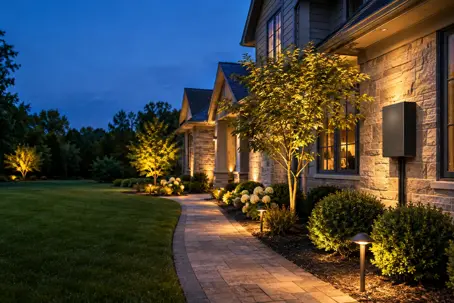
Landscape Lighting Transformer Guide: Choosing the Right Power Supply for Your Lights
At the heart of most effective outdoor lighting systems lies a crucial component: the landscape lighting transformer. An outdoor lighting transformer regulates power by converting standard household voltage to a lower, safer level suited for outdoor use.
Without the right transformer, outdoor lights may flicker, overload, or waste energy.
Choosing a proper transformer ensures your lighting system runs safely, lasts longer, and supports advanced features like timers or smart control.
What Is a Landscape Lighting Transformer?
A landscape lighting transformer reduces the standard 120-volt household current to a much lower voltage (usually 12 or 24 volts) that suits outdoor lighting systems (including LED fixtures).
The transformer connects to a GFCI-protected outdoor outlet, as mandated by the National Electrical Code, and uses internal coils to step the voltage down. This voltage conversion makes it possible to power landscape lighting without overheating wires or creating electrocution risks.
Most transformers sit in weatherproof boxes near the lighting zone and supply power to path lights, spotlights, and decorative features.
In professionally designed landscape lighting services, transformer placement, voltage settings, and wire gauge all work together to support safe, consistent results.
Why Is a Transformer So Important?
The landscape lighting transformer is what makes outdoor lighting systems work safely and consistently. While often overlooked, transformers play one of the most important roles in outdoor lighting design.
As more homeowners choose low-voltage and smart outdoor lighting, transformer selection has become more important than ever. Industry research (Allied Market Research) expects the outdoor lighting market to grow to nearly 28 billion dollars by 2030, with much of that growth tied to energy efficiency and connected technology. Every one of these low-voltage outdoor lighting systems needs a transformer at its core.
So here’s why the landscape lighting transformer is crucial to your lighting system:
- It reduces voltage to a safe level
Voltage reduction makes outdoor lighting systems safe for everyday use and helps prevent electric shock or fire hazards. - It protects the fixtures from damage
Lights connected directly to full household power can overheat, burn out quickly, or fail completely. A transformer regulates voltage and prevents dangerous power surges that could ruin your property. - It delivers consistent power across the system
A landscape lighting transformer keeps power flow balanced. Without a transformer, lights farthest from the power source might flicker or dim while others stay bright. - It supports zones, timers, and dimmers
Some transformers allow you to divide your yard into lighting zones. Lighting zones let you dim path lights while keeping spotlights bright, or schedule different areas to turn on at different times. - It enables smart features
Modern landscape lighting transformers often include WiFi or Bluetooth connectivity. You can control these new–age transformers through apps, voice assistants like Alexa or Google, or automation systems that adjust based on time, motion, or daylight.
Types of Landscape Lighting Transformers
Different landscape lighting transformers offer different levels of control, flexibility, and installation complexity. Choosing the right transformer depends on your system size, control preferences, and how much power you need to manage across your yard.
- Manual transformers
Manual transformers use a built-in timer or switch to control when the lights turn on and off. Manual transformers offer the most basic level of control and are best suited for simple, predictable setups.
You might choose a manual transformer if:
- You have a small system with a fixed lighting schedule.
- You don’t mind adjusting the settings by hand.
- You prefer a lower-cost option with no digital components.
Most manual transformer models do not retain settings after a power outage, so you may need to reset them manually. Over time, mechanical timers can also lose precision and may need to be replaced.
- Digital transformers
Digital transformer models come with programmable clocks and light sensors (photocells) that automate your lighting schedule. These automatic transformers can adjust based on daylight, so you don’t need to reset them often.
A digital transformer makes sense if:
- You want lights to turn on at dusk and off at dawn automatically.
- Your schedule varies, and you want weekly presets.
- You prefer automation without smart home apps.
Many digital transformers include a battery backup that saves your settings during a power outage.
- Smart transformers
Smart transformers connect to your phone, tablet, or home assistant through WiFi or Bluetooth. Smart transformers offer the most flexibility via remote control and voice commands.
Smart features may be a good fit when:
- You want to control lights from your phone or voice assistant.
- You plan to dim or adjust lighting scenes throughout the week.
- You value integration with systems like Alexa or Google.
Some smart transformer apps are completely free, while others may charge for advanced features. Make sure your home’s network can support the connection with a smart transformer, and always check compatibility with your fixtures and voltage needs.
- Multi-tap transformers
Multi-tap transformers offer several voltage output points, which helps compensate for voltage drop in longer or uneven wire runs and keeps all lights shining evenly.
Choose a multi-tap transformer if:
- Your fixtures are spread across a large yard or commercial property.
- You notice dimming in lights farther from the power source.
- You want more control over voltage delivery to different lighting zones.
Although flexible, multi-tap transformers require careful planning and professional installation. Incorrect tap usage can damage fixtures or cause uneven lighting.
- Magnetic transformers
Magnetic transformers use heavy copper windings and a steel core to step down voltage. Magnetic transformers are durable and stable under high loads, which makes them ideal for demanding/large-scale installations.
Choose a magnetic transformer when:
- You need a reliable option for a large or high-wattage system.
- You want compatibility with both halogen and LED fixtures.
- You prefer a longer-lasting, weather-resistant unit.
Magnetic transformer models are heavier than other types and may require sturdy mounting. Some magnetic transformers produce a faint humming sound during operation, which could be noticeable in quiet outdoor areas.
- Electronic transformers
Electronic transformer types are smaller and lighter, using internal circuitry rather than magnetic coils. Electronic transformers are easier to install in tight spaces, but can be more sensitive to load and moisture conditions.
Consider an electronic transformer if:
- Your lighting system is compact and low-wattage.
- You need a lightweight unit for limited installation space.
- You understand the fixture compatibility limits with some LEDs.
Electronic transformers may struggle to power very low-wattage LED setups and often require a minimum load to function properly. Electric transformers also deteriorate faster if installed in areas with heavy moisture exposure.
How to Choose the Right Transformer
Choosing the right transformer depends on several technical and design factors. A well-matched transformer helps the lighting system run smoothly, avoid overload, and support the features you plan to use. Here are the most important factors to consider when buting a landscape lighting transformer:
- Wattage capacity
Every transformer has a maximum load it can safely carry. A landscape lighting system should use no more than 80 percent of transformer capacity to prevent flickering, heat damage, and early failure.
Most modern outdoor lighting systems use LED landscape lights, which reduce overall power demand. LED lights use up to 75 percent less energy than incandescent bulbs, per the U.S. Department of Energy. Using LED lighting is already an energy-efficient choice, but it does not replace the need to size a landscape lighting transformer correctly.
How to calculate transformer wattage capacity:
Add the wattage of every fixture in your lighting layout, then divide the total by 0.8 to find the minimum transformer size required.
Formula:
Transformer size = total fixture wattage ÷ 0.8
Example:
Landscape lighting wattage calculation
| Fixture type | Quantity | Wattage per fixture | Total wattage |
|---|---|---|---|
| Path lights | 6 | 4 watts | 24 watts |
| Spotlights | 2 | 6 watts | 12 watts |
| Floodlight | 1 | 10 watts | 10 watts |
| Total fixture load | 46 watts |
46 ÷ 0.8 = 57.5 watts
Choose a transformer rated for at least 60 watts.
Pro tip
Some professionals multiply the total by 1.25 instead of dividing by 0.8. Both approaches apply the same 20 to 25 percent safety buffer.
- Number of zones
A lighting zone is a set of fixtures that turn on and off at the same time or share the same brightness setting. Zones allow different parts of a property to function independently, such as keeping the driveway lights on all night while turning off garden lights earlier.
A landscape lighting transformer must have multiple output terminals or zone control features to support separate lighting groups. Some models include built-in zone settings, while others require smart controls to adjust each group.
Each zone needs its own wire run from the transformer. You cannot split zones later without rewiring. Plan your layout in advance if you want to control areas like the front yard, backyard, or patio separately.
- Control preferences
A landscape lighting transformer must match how you want to control your lights. Transformer control types include manual switches, programmable timers, photocell sensors, app-based smart controls, and voice automation.
- A manual switch turns lights on and off directly, and works best for small systems you can reach easily, such as a setup near a garage or back door.
- A timer turns the system on and off at set times each day. Timers are useful when your schedule stays consistent, like 6 p.m. to 11 p.m. daily.
- A photocell sensor reacts to changes in light. Photocell sensors turn lights on at dusk and off at dawn without manual input. The photocell transformer option suits lighting systems that need to run automatically every night, like security lighting.
- A smart control system lets you dim lights, adjust zones, or change schedules through a mobile app, and from anywhere. Many smart models also support voice assistants like Alexa or Google.
Smart transformers need a strong internet connection near the unit. A weak signal near the transformer can interrupt app features, voice commands, or scheduled settings. Use a weather-rated WiFi extender if the router signal does not reach the installation area..
Pro tip
Choose a control method based on how often you want to adjust your lights. If your needs change often, use a smart system. If your schedule is fixed, a timer or photocell may be enough.
- Fixture types
Every landscape lighting transformer should support the total wattage and the dimming or performance features of every fixture in the system. Matching the wrong transformer to your fixtures can cause flickering, poor brightness, or system failure.
Most landscape lighting fixtures today use LED bulbs, but not all LEDs behave the same. Some LED lights are dimmable, others are not. Some LEDS also require a minimum load to function correctly.
A low-wattage LED system under 20 watts may not trigger certain electronic transformers. For example, a transformer that needs a 20-watt minimum load will not power a system that only draws 12 watts. If you plan to install a small system or only a few fixtures, choose a transformer that works with low total wattage.
Dimmable LED fixtures also require a lighting transformer that supports dimming. Many magnetic transformers work with dimmable LEDs, while some electronic models do not.
Mixed light fixture types in one system can create compatibility issues. Do not combine halogen and LED fixtures on the same line unless the transformer is rated for both.
- Distance
The landscape lighting transformer should power the entire wiring run without voltage loss. As electricity travels along a wire, it encounters resistance that causes the voltage to drop. Longer runs and thinner wires amplify this drop, which results in dim or flickering lights at the far end of the run.
Thicker wire reduces resistance and preserves voltage over distance. Wire gauge follows the American Wire Gauge (AWG) system, where a lower number means thicker wire.
Most wire cables have the AWG rating printed on the insulation. Look for markings such as 14 AWG, 12 AWG, or 10 AWG printed repeatedly along the length of the wire.
The table below shows recommended copper wire gauges for low-voltage runs.
Wire gauge guidelines (12‑Volt landscape systems)
| Wire run length | Recommended wire gauge |
|---|---|
| Up to 100 feet | 14 AWG |
| 100 to 150 feet | 12 AWG |
| Over 150 feet | 10 AWG |
The table above assumes a 12-volt system using copper wire and a typical load of 50 to 100 watts per run. Higher loads may require thicker wire even at shorter distances.
The goal is to keep voltage drop within three percent of the source voltage to maintain consistent brightness.
Some transformers include multi-tap terminals that offer higher output voltages, such as 13 or 14 volts. These transformer taps help compensate for voltage loss on longer runs.
Connecting distant fixtures to a higher tap helps maintain even lighting. For example, a 150-foot run using 12 AWG wire may require a 14-volt tap to keep fixtures at full brightness. Fixtures closer to the transformer can use a 12-volt tap with 14 AWG wire.
Pro tIp
Keep each wire run under 200 watts. Avoid combining high-wattage and low-wattage fixtures on the same line unless the wire and transformer can support the total load evenly.
- Weatherproof rating
Look for a landscape lighting transformer that is UL 1838 listed. A UL 1838 listing confirms that the transformer meets safety requirements for low-voltage landscape lighting systems, including fire resistance, electrical insulation, and moisture protection.
In addition to UL certification, confirm the level of protection provided by the transformer’s enclosure. The label or product specs should include either an IP rating or a NEMA enclosure type, which describes how well the enclosure prevents water, dust, and other particles from entering.
IP ratings follow the IEC 60529 standard by the International Electrotechnical Commission, and are written as two-digit codes. The first digit of an IP rating shows protection against solids, while the second shows resistance to water.
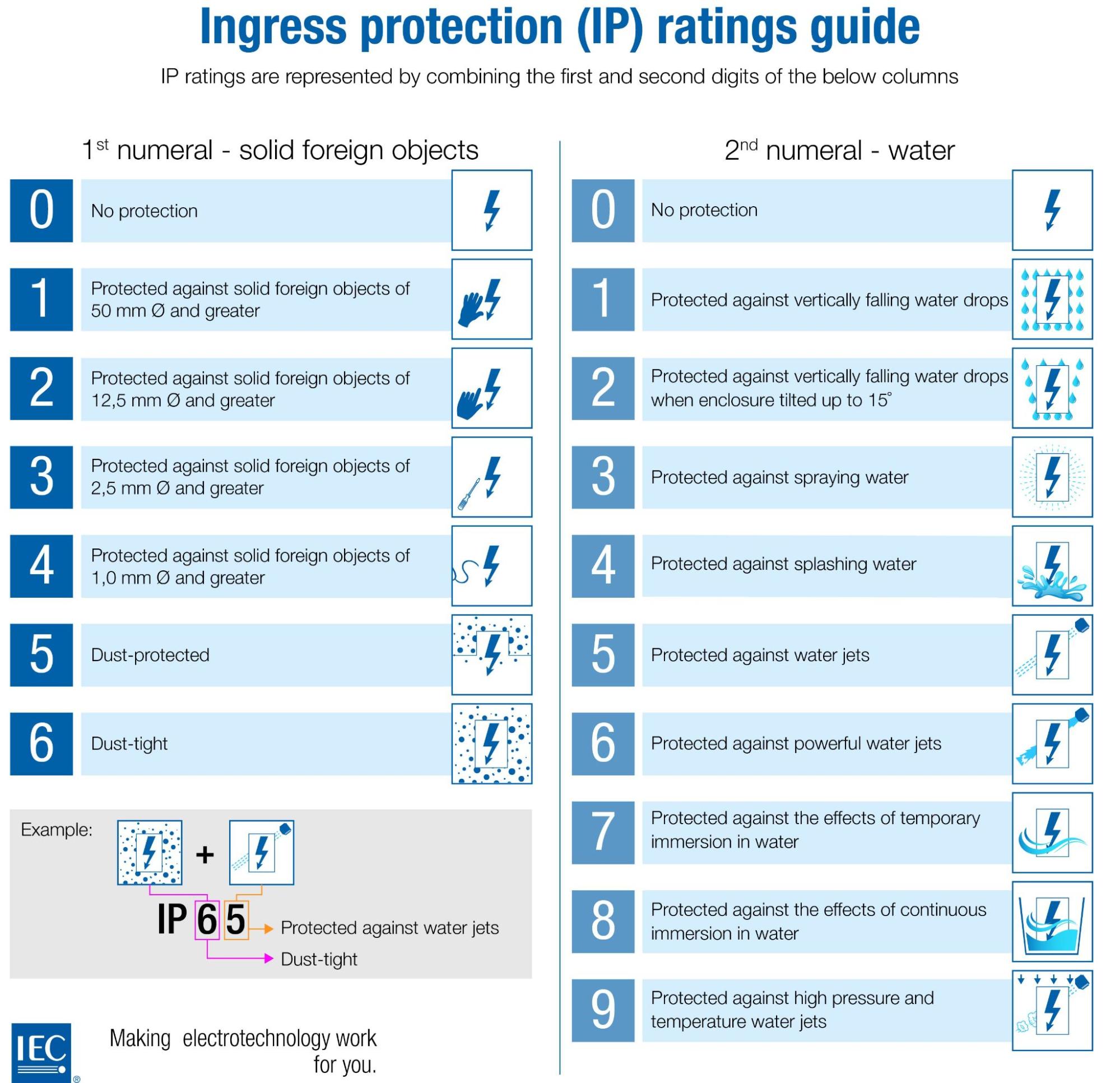
For general landscape lighting, use a transformer rated IP65. For areas near water or prone to heavy rain, use IP67.
NEMA ratings follow the NEMA 250 standard and are widely used in North America. NEMA ratings describe enclosure strength against rain, sleet, dust, ice, and corrosion. Use at least NEMA 3R for basic outdoor installations. Use NEMA 4X for coastal or wet environments.
If a transformer lacks a UL 1838 listing, do not install it outdoors—even if it has an IP or NEMA rating.
Pro tip
Do not install transformers directly on the ground or near standing water. Mount the unit on a wall or post, several inches above ground level, with space around it for airflow.
Smart Power-Efficient Features to Look For in a Transformer
Once the transformer handles power and safety needs, the next step is to look at features that support everyday convenience and long-term efficiency. Smart options and built-in automation can make outdoor lighting easier to manage and more cost-effective over time.
The features below are worth considering if ease of use and energy savings are part of your landscape lighting goal:
- WiFi or Bluetooth connectivity: Provides remote control of the lights through an app, which helps when the transformer is mounted out of reach.
- Smart home compatibility: Connects with Alexa or Google Assistant, so the lights can run on voice commands or daily routines.
- Timers and photocell sensors: Turn the lights on at dusk and off at dawn without needing manual adjustments.
- Dimming and zone control: Adjusts brightness levels or separates front yard lighting from backyard lighting for a more customized control.
- Scene presets and seasonal schedules: Switch lighting setups for holidays, events, or seasonal routines without manual adjustments or rewiring.
Why Work With a Professional Lighting Installer?
Transformer issues are some of the most common reasons outdoor lighting systems underperform. If the power source is mismatched to the design, lights may dim, flicker, or wear out faster than they should.
Working with a professional helps prevent all of that. At Blingle, every landscape lighting project begins with a customized transformer plan that fits your lighting layout, your property, and your lighting goals.
We also handle all lighting installations with safety and reliability in mind. That includes properly sized wiring, grounded systems, and code-compliant integration with the existing power supply.
Blingle also offers ongoing support through our full range of outdoor lighting services. From smart upgrades to system expansions and seasonal adjustments, you’ll always have a team that knows your setup and how to keep it working at its best.
Power Up Your Landscape Design
A reliable transformer is the starting point for any well-built outdoor lighting system. It keeps the lights steady, supports smart features, and helps the full design last longer.
Need help planning the perfect landscape lighting setup? Contact your local Blingle provider to schedule a consultation and get expert support from day one.